
|14 min read

Last updated on July 01, 2026
Last updated on July 01, 2026
.png)
You're spending money on paid ads and are not sure which channel is working or why. The platform isn't usually the problem. Running channels without a framework for what each one does and how they fit together is.
This guide covers every paid advertising channel available to roofing companies: what each one is built for, which to start with, how to split a budget, and what numbers tell you it's working. If you're new to PPC for roofers or restructuring campaigns that aren't converting, start here.
Quick Answer
Roofing PPC (pay-per-click advertising) is paid digital advertising where you control your spend and pay when a homeowner takes action: clicks, calls, or direct messages. The four main channels are Google Search Ads (high-intent queries), Local Services Ads (pay-per-lead, appearing above standard Google Ads), Facebook and Instagram Ads (awareness and retargeting), and YouTube Ads (brand recall). Most residential roofing companies start with LSA or Google Search to capture in-market demand, then layer in Facebook once the Google campaigns are converting. Monthly ad spend typically ranges from $1,500 in smaller markets to $6,000+ in major metros.
Roofing PPC covers every paid digital channel where you control spend and pay when a homeowner takes action: from search and pay-per-lead ads to social and video.
Running only one channel typically means missing homeowners at every other stage of their decision-making. The market is becoming more competitive: 89% of roofing contractors anticipate sales growth over the next three years, per Roofing Contractor magazine's 2026 State of the Industry Report. (Source: Roofing Contractor) More contractors competing for the same homeowners means the companies with the most complete paid presence win more jobs.
For the full picture of roofing marketing beyond paid channels, including SEO, referrals, and content, roofing marketing covers the complete mix. This article stays focused on paid: how to choose channels, how to allocate budget, and what to measure.
The four PPC channels roofing companies use are Google Search Ads, Local Services Ads (LSA), Facebook and Instagram Ads, and YouTube Ads. Each one reaches a homeowner at a different point in their decision-making process. None of them does the same job.
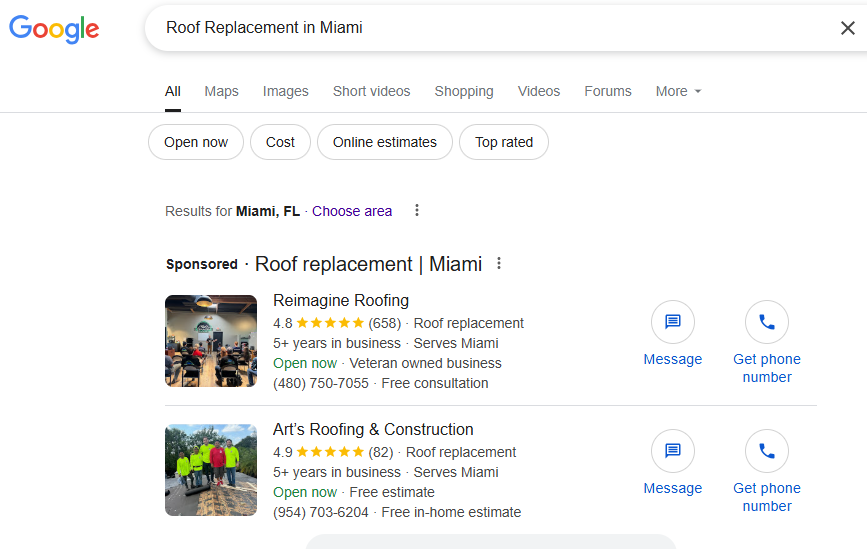
Google Search Ads put your company at the top of results when a homeowner types "roof repair near me" or "storm damage roofer [city]." You pay per click. The homeowner is already looking. Your ad is the answer.
Search ads work best for high-intent queries: emergency repairs, leak fixes, and replacement estimates. A homeowner searching for a roofer at 7pm after a hail storm isn't browsing. They're ready to call. Search ads capture that moment.
The tradeoff: clicks are expensive in competitive markets, and you need a well-structured campaign and a converting landing page to make the math work. For the full setup, including campaign structure, keyword match types, bidding strategy, and Quality Score optimization, the Google Ads guide for roofers covers it in detail.
Local Services Ads appear above standard Google Ads in search results. They show your company name, star rating, and a Google Guaranteed badge. You pay per lead, not per click meaning you only spend when a homeowner contacts you directly.
LSA requires verification and ranks on reviews, responsiveness, and proximity. The full verification process and ranking factors are in the Google Ads guide for roofers.
One step before applying: LSA approval requires a verified, fully built-out GBP. If yours isn't current, see Google Business Profile for Roofers before starting the application.
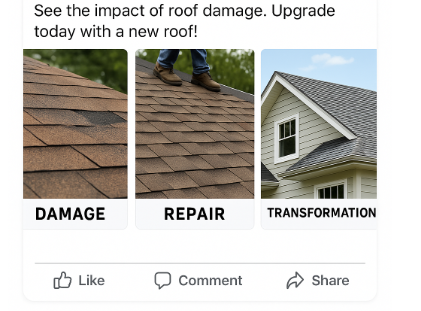
Facebook and Instagram ads reach homeowners before they search. A homeowner who noticed hail damage on her roof may not search "roofer" for days, but she's on Facebook tonight
Facebook marketing for roofing companies is one of the highest-ROI channels for storm-event targeting and retargeting homeowners who have already visited your site. The cost per click is lower than Google's, which makes it efficient for top-of-funnel reach. The leads are less urgent than search leads but warmer than cold referrals, and you control the volume.
YouTube ads appear before or during videos and across Google's display network. For roofing, they work best for brand recall: showing a short video to homeowners in your service area who've already visited your website or searched roofing-related keywords.
YouTube won't generate the same level of direct lead volume as LSA or Search, but it reinforces your company name among homeowners in the consideration phase. If your Google campaigns are already running and you want to strengthen conversion from awareness to call, YouTube is a cost-effective layer to add.
Channel Comparison
|
Channel |
Best for |
Cost model |
When to start |
|
Google Search Ads |
High-intent emergency and replacement queries |
Pay per click |
Once you have a converting landing page |
|
Local Services Ads |
Verified, trust-driven leads above the fold |
Pay per lead |
After GBP is verified and optimized |
|
Facebook / Instagram |
Storm-event reach, awareness, retargeting |
Pay per click |
After Google has consistently converted |
|
YouTube |
Brand recall, retargeting site visitors |
Pay per view |
When Google and Facebook are both established |
Start with Local Services Ads if you can get verified, or Google Search Ads if LSA verification is still pending.
Before committing to LSA, check two things: your GBP must be fully verified and optimized, and Google requires at least 5 reviews before LSA ads appear in most service categories. (Source: Google Local Services Ads Help) If you're below that threshold, prioritize reviews before applying.
Start with Local Services Ads if your GBP is optimized, your reviews are solid, and your license and insurance are up to date. The pay-per-lead model removes wasted click spend. The Google Guaranteed badge drives trust with homeowners. Placement above standard Google Ads gives you maximum visibility at the top of the page.
Start with Google Search Ads if LSA verification is pending or you need lead volume faster. Search campaigns go live within days. You control which keywords trigger your ads and can build separate campaigns for each service: replacement, repair, and storm damage.
Add Facebook after your Google campaigns are converting consistently. Facebook generates top-of-funnel demand and retargeting reach. Running it before Google is optimized means paying to create awareness for leads your follow-up process can't yet handle.
|
Goal |
Start with |
Add next |
|
Emergency repair leads fast |
Google Search Ads |
LSA once verified |
|
Replacement and full-install jobs |
LSA and Google Search |
Facebook for retargeting |
|
Storm-event canvassing |
Facebook geographic targeting |
Google Search to capture search intent |
|
Commercial roofing leads |
Google Search (commercial keywords) |
See commercial roofing marketing |
A common allocation for roofing companies running a balanced paid strategy is 60–70% toward Google (split between LSA and Search) and 30–40% toward Facebook, with total spend scaled by market size.
Starting budget by market:
These are ad spend figures, not management fees. YouTube enters the mix when total monthly spend exceeds $4,000; below that threshold, the budget is better allocated to LSA, Search, and Facebook, where direct lead return is highest.
When you're ready to hand campaigns to a team tracking cost per booked appointment rather than just cost per click, Rizen's paid ads management is built for home service operators at this level.
Severe convective storms generated more than $50 billion in U.S. insured losses in 2025, the third consecutive year above that mark. (Source: Insurance Information Institute) When a storm event hits your market, raise your daily caps immediately, add storm-specific keywords to Search, and run Facebook geographic ads to affected zip codes at the same time. The homeowners who notice damage on Monday are searching for roofers by Wednesday and booking by Friday.
Pulling spend entirely in slower months costs more than it saves. Competitors who go dark leave impression share open. Maintain a base budget on your highest-converting keywords and keep Facebook retargeting active through off-peak months, then scale back up as demand returns.
The traditional roofing ads that produce the best return alongside digital PPC are direct mail, door hangers, yard signs, and truck wraps.
These work not as replacements for paid digital channels, but as reinforcement in the neighborhoods where you're already active.
After completing a job, canvassing the surrounding block with door hangers is one of the highest-conversion offline tactics available to roofers. Neighbors saw your crew and your truck and know their roof is the same age as the one you just replaced. A well-timed door hanger with a clear offer captures that demand before it turns into a Google search for someone else.
Storm-triggered demand is significant: State Farm paid out more than $5.6 billion in hail-related claims in 2025. (Source: State Farm Newsroom) Targeted postcards to storm-affected zip codes, mailed within 48–72 hours of a hail event, reach homeowners while urgency is highest and before competitors arrive.
Yard signs during active jobs are a form of passive brand-building in the neighborhoods where it matters most. A homeowner driving past a job site with your sign is more likely to remember your name when her own roof needs attention.
Truck wraps extend that visibility across your entire service area. Every truck on the road is a moving advertisement, and the cost per impression over the life of a wrap is among the lowest of any channel you'll run.
Homeowners rarely make a decision from a single touchpoint. They see your yard sign, search for your company name, check your Google reviews, then fill out a form. Each touchpoint reinforces the last.
When your offline presence is consistent, with the same company name, phone number, and website across every channel, it strengthens your digital attribution too. A homeowner who saw your door hanger and then searched your name is a trackable lead the moment they reach your site or call your number.
The four metrics to track across all your roofing PPC channels are cost per lead, cost per booked appointment, lead-to-appointment rate, and appointment-to-close rate.
Most operators track CPL and stop there. Cost per lead tells you which channel is cheapest to generate a contact. Cost per booked appointment tells you which channel is worth scaling.
Four numbers in detail:
Assign a unique phone number to each channel: one for Google Search, one for LSA, one for Facebook. When a lead calls, you know exactly where they came from. Combined with UTM parameters on your landing page URLs and conversion events in Google Tag Manager, you stop guessing which channels produce booked jobs and start seeing it directly in your dashboard.
For what happens after a lead calls, including qualification, estimate, and close, see The Complete Guide to Roofing Sales. For tracking it all in one place, the CRM comparison for roofers covers the leading platforms side by side.
Below $1,500/month in most markets, you won't generate enough data to know what's working. Campaigns need volume to identify converting keywords, adjust bids, and catch waste before it compounds. What the right number looks like by market size is covered in the budget section above.
Both serve different functions and work best together. LSA is pay-per-lead, appears above standard Google Ads, and carries the Google Guaranteed badge, which drives higher trust and call-through rates than a standard text ad. Google Search gives you more control over keywords, match types, and landing page destinations. Most residential roofing companies benefit from running both: LSA captures the highest-intent clicks above the fold, while Search covers the full range of relevant queries below it
Yes, but the approach differs significantly from residential. Commercial buyers, including property managers and facility managers, search with different terms, have longer decision cycles, and respond to different ad copy and landing page formats. Commercial campaigns lean heavily on Google Search with commercial-intent keywords. The commercial roofing marketing guide covers the full commercial segment in detail.
PPC produces leads immediately and requires ongoing spend to maintain visibility. SEO builds organic rankings over time, and once established, you're not paying per click. Most roofing companies need both: PPC fills the pipeline now, while SEO lowers long-term cost per lead. The roofing SEO plan covers the organic side in full.
Google Search and LSA can generate leads within the first week of going live. The first 30–60 days are primarily data collection: identifying which keywords and audiences convert, building negative keyword lists, and tightening bids. Most campaigns reach consistent, predictable performance by the 90-day mark.
Pausing completely resets your campaign's learning. Google needs time to re-learn which searches, times, and audiences convert for your account, and rebuilding that after a full pause can take weeks. Reduced base spend during slower months avoids that reset entirely while keeping your costs down until peak season returns.
Your schedule doesn't fill itself. The roofing companies that stay booked year-round aren't guessing which channel is working. They know their cost per booked job by channel, every week, and they adjust when the numbers shift.
If you want that kind of visibility into your paid ads, If you want that kind of visibility into your paid ads, start with a Growth Diagnostics audit with Rizen. . We'll review your current channels, show you where leads are falling out, and map out what a full-funnel PPC setup looks like for your market and budget
No Comments Yet
Let us know what you think