
Pool Builders
|6 min read

Last updated on September 08, 2026

A pool referral program is a structured system for turning happy customers into a repeatable source of new business, instead of hoping word of mouth happens on its own. Pool building and service work runs on trust more than almost any other home service, so a referral from a neighbor carries more weight than any ad you could run. This guide covers building one from scratch. It's one piece of a broader swimming pool marketing strategy.
The five parts of a working referral program:
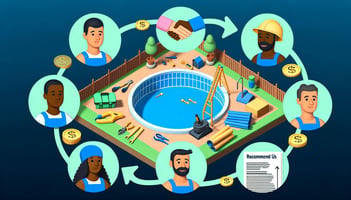
Referral programs work because they lower your cost to acquire a customer while raising the quality of the customer you get. A referred lead already trusts you before the first call, since Nielsen's Global Trust in Advertising research has found that 83% of people trust recommendations from friends and family over any other form of advertising, which means a referred homeowner tends to convert faster and question your pricing less than someone who found you cold through an ad.
Referrals also compound. Every satisfied customer who refers a friend creates a second customer who can refer someone else, and pool projects are visible, photographable, and genuinely exciting to talk about, which makes them easier to refer than most home services. The byproduct is reputation: a steady stream of referrals signals to everyone else watching, including people reading your reviews, that real customers are happy enough to put their own name behind you.
You set goals the same way you'd set any marketing goal: specific, tied to a number, and tied to a timeframe. "Get more referrals" isn't a goal; it's a wish. "Generate 15 referred leads per quarter" or "grow referred revenue to 20% of total sales within two quarters" gives you something to actually measure the program against.
Pick one or two metrics up front rather than tracking everything at once. A new program is easier to evaluate against a single, clear target than against a dashboard of numbers with no baseline yet.
You structure the reward around what actually motivates your specific customers, not a generic gift card. Pool customers respond well to rewards tied to their pool itself:
The reward should feel proportional to the size of the job you're rewarding for; a $50,000 pool build referral deserves a bigger thank-you than a one-time cleaning referral.
Reward the new customer too, not just the person who referred them. A two-sided program, "you get a $150 credit, your friend gets $150 off their first service," gives the referred homeowner an actual reason to follow through and call instead of just filing the recommendation away. One-sided programs rely entirely on the referrer's goodwill to close the loop; two-sided programs give both people a reason to act.
Keep the referral process itself simple. If a customer has to fill out a multi-field form, find a referral code, and explain the process to their friend, most won't bother. A single shareable link, or a simple "just give them my number and mention your name," removes the friction that kills most referral programs before they start.
You promote it the same way you'd promote anything else: consistently, across the channels your customers already use.
A pool referral bonus that nobody knows exists doesn't generate referrals, no matter how generous it is.
At the walkthrough, something as simple as this works better than a generic "let us know if you have any friends interested": "A lot of our new customers come from happy clients like you. If you know anyone thinking about a pool, send them our way; we'll take care of you both." It names the program without turning the moment into a sales pitch, and the same line adapts easily into the subject of a follow-up email: "Know someone who wants a pool like yours?"
Consistency matters more than any single channel. A program mentioned once in an email and never again fades from memory by the time a customer's neighbor actually asks who built their pool.
Social proof reinforces referrals by giving the person being referred a reason to believe the recommendation. Testimonials, online reviews, and social media posts showcasing real projects all do double duty: they support your general marketing and give a referred homeowner something to check before they call, confirming that their friend's recommendation was right.
Encourage customers who are already referring you to also leave a review or share their project on social media. A referral plus a public review is a stronger signal than either one alone.
You track it with a small set of concrete metrics:
Without these numbers, you're running the program on faith.
Dedicated referral-tracking software can automate the tracking, but a shared spreadsheet works fine for a program that's just getting started; the metrics matter more than the tool. Once you have a few months of data, adjust based on what you're actually seeing: raise the reward if referral volume is low but conversion is high, tighten qualification if you're getting referrals that never close, or simplify the ask if customers say the process feels like a hassle. Ask your referrers and the people they refer directly what worked and what didn't; that feedback usually points to the fix faster than the data alone.
It depends on the size of the job, but a common approach is scaling the reward to the referred project's value, a smaller reward (a service discount or gift card) for a cleaning or repair referral, and a more substantial reward (cash, a free upgrade, or a significant service credit) for a new pool build referral.
Tiered rewards that increase with each additional referral, a "refer a neighbor" angle that plays on the fact that pool projects are highly visible on a street, and pairing the referral ask with a request for a public review both work well beyond a flat one-time reward.
A referral program is a structured, ongoing system built around your existing customers and a defined reward; a general advertising idea is a one-off tactic aimed at reaching new people who don't know you yet. Our advertising ideas guide covers the latter in depth.
No. A spreadsheet and a consistent follow-up habit can run a small program well. Dedicated referral software becomes worth the cost once volume grows enough that manually tracking who referred whom becomes a real-time cost.
Expect a lag between launch and your first wave of referrals, since it depends on your customers' own project timelines and when they naturally think to mention you. Most pool companies see meaningful referral volume within one to two full sales cycles of consistent promotion, not the first few weeks.
A referral program only works if someone keeps it running: promoting it consistently, tracking the numbers, and following up on every lead it produces. That's the part most pool companies let slip after the first month.
At Rizen, we've built lead-generation systems for home service businesses, including pool companies, since 2014, and referral tracking is part of the same pipeline as every other channel, not a side project nobody owns. Explore our Paid Ads Management and lead-gen services, or book a free strategy call to talk through what a referral program could look like for your business.
These Stories on Roofers



No Comments Yet
Let us know what you think